Vitamin B-6:
“An understanding of the various forms and quantities of these forms in foods is important in the evaluation of the bioavailability and metabolism of vitamin B-6”… one of the forms that vitamin B-6 exists is in the form of “5’0-(beta-D-glycopyransosyl) pyridoxine. To date only plant foods have been found to contain this interesting form of vitamin B-6” [3]. Yeast and brown rice contain more natural Food vitamin B-6 than other Foods [4]. Vitamin B-6 was first reported in the 1930s [5]. At least one synthetic vitamin B-6 analogue has been found to inhibit natural vitamin B-6 action [6]. Pyridoxine HCL (hydrochloride) which is found in most non-Food supplements, is made with petroleum ester combined with HCL and processed with formaldehyde [7].
“Disorders treated with (B-6)…include Down’s syndrome, autism, hyperoxaluria, gestational diabetes, carpal tunnel syndrome, depression, and diabetic neuropathy”, but the results are consider by some in the mainstream as having “limited value” [1]. Vitamin B-6 is considered to be a first-line treatment for Lennox-Gastaut and some other seizure disorders [8,9]. Many problems including anemias, premenstrual dysphoric disorder (PMDD), PMS, cardiovascular complaints, confusion, depression, irritability, and certain immune problems have responded to vitamin B-6 [9]. A study of healthy elderly individuals found about 1/3 had marginal vitamin B-6 deficiency [9].
Vitamin B-12:
Initially Food vitamin B-12 was given for people with pernicious anemia in the form of raw liver, but due to cost considerations a synthetic USP isolate (cyanocobalamin) was developed [6]. Cyanocobalamin, the common pharmacological (USP) form of vitamin B-12, is essentially cobalamins combined with cyanide! [6]. The only two naturally active forms of vitamin B-12 in the human body are methylcobalamin and deoxyadenosylcobalamin and those are in Food [1]. Vitamin B-12 when ingested in its human-active form is non-toxic [1], yet some researchers have concluded “The efficacy and safety of the vitamin B-12 analogues created by nutrient-nutrient interaction in vitamin-mineral supplements is unknown” [10]; interestingly some synthetic vitamin B-12 analogues seem to be antagonistic to vitamin B-12 activity in the body [11,12]! Insufficient vitamin B-12 results in anemia, degeneration of peripheral nerves, and skin hypersensitivity [1,2].
“Vitamin B12, cobalamin, is indispensable for humans owing to its participation in two biochemical reactions: the conversion of l-methylmalonyl coenzyme A to succinyl coenzyme A, and the formation of methionine by methylation of homocysteine” [13].
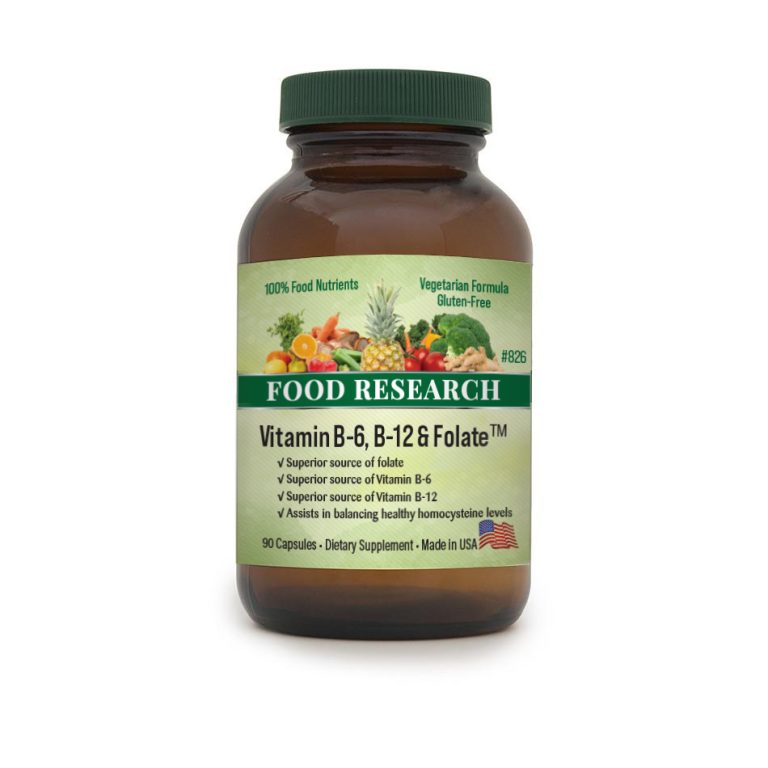
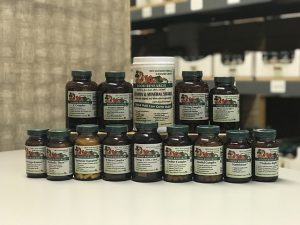
100% Food Vitamin B-6, B-12, & Folate contains methylated vitamin B-12, a superior form [14].
Vitamin ‘B-9’, Folate:
The vitamin once known as B-9 exists in foods as folate. Initially Food folate was given for people with a pregnancy-related anemia in the form of autolyzed yeast; later a synthetic USP isolate was developed [1]. Pteroylglutamic acid (folic acid), the common pharmacological (USP) form of folate is not found significantly as such in the body [1].
“Folic acid is a synthetic folate form” [9]. Folic acid, such as in most supplements, is not found in Foods, folate is [19]. Insufficient folate can result in fatigue, depression, confusion, anemia, reduced immune function, loss of intestinal villi, and an increase in infections [2]. Folate deficiency is the most important determinant in high homocysteine levels [11], and supplemental folate is effective in reducing homocysteine [15,16]. “The highest concentrations of folate exist in yeast…” [1]. Insufficient folate can result in fatigue, depression, confusion, anemia, reduced immune function, loss of intestinal villi, and an increase in infections [2]. “(C)onsumption of more than 266 mcg of synthetic folic acid (PGA) results in absorption of unreduced PGA, which may interfere with folate metabolism for a period of years” [1].
A 2004 paper from the British Medical Journal confirmed what many natural health professional have known all along: since folic acid is unnatural and the body cannot fully convert large amounts of it into usable folate, this artificial substance can be absorbed and may have unknown negative consequences in the human body [17], folate supplementation obviously should be in Food folate forms and not folic acid!
Many scientists have concerns about folic acid [18]. High consumption of folic acid is dangerous [20].
Vitamins B-6, B-12, and Folate are all important nutrients for healthy blood; the absence of any of them can trigger various forms of anemia (especially pernicious anemia) [1,18]. Subclinical deficiencies in vitamin B-12, vitamin B-6, and folate may impair cognitive function [21].
Homocysteine responds to vitamin B-12 and folate [16]. Dr. Mason of Tufts University School of Medicine reports that a 20% elevation of homocysteine significantly increases the risk of cardiovascular disease [12]. Normal homocysteine level is about 12 umol/L, while cardiovascular risk increases about 14-16 umol/L [22]. In addition, even if blood tests for vitamin B-12 or folate appear to be normal, this may be because results are masked by an elevated level of homocysteine. Homocysteine is highly implicated in vascular diseases (such as cardiovascular and other vascular disorders), and can be reduced with sufficient vitamin B-12 and Folate; with vitamin B-6 sometimes playing a supporting role [16].
Superoxide Dismutase:
“Superoxide dismutase (S.O.D.) is one of the most important enzymes that function as cellular antioxidants…The absence of this enzyme is lethal” [1]. “It protects intracellular components from oxidative damage, converting the superoxide ion to hydrogen peroxide” [1]. S.O.D. is a powerful free radical scavenger which has been clinically shown to protect the brain, heart, liver, lungs, kidneys, skin, muscles, penis, nerves, and spinal cord from ischemic injury [23]. High levels of S.O.D. have been associated with reduced growth of Candida albicans [24]. 100% Food Vitamin B-6, B-12, and Folate naturally contains S.O.D.
Organic Brown Rice also a Food complex source of silicon and B vitamins [2,25-28].
Since Vitamin B-6, B-12, & Folate contains only Foods, unlike other isolated supplements, it also naturally includes vitamin B-1 (thiamin), vitamin B-2 (riboflavin), vitamin B-3 (niacinamide), vitamin B-5 (pantothenate), choline, inositol, and other B vitamin factors which often work with vitamins B-6, B-12, and folate in the body. All these factors make 100% Food Vitamin B-6, B-12, & Folate the choice for doctors interested in truly natural health.
Many females simply take Vitamin B-6, B-12, & Folate as a Food supplement to help them feel better.